The useful starting point
A refrigerant decision combines process performance, equipment, safety, service capability and the applicable regulatory pathway.
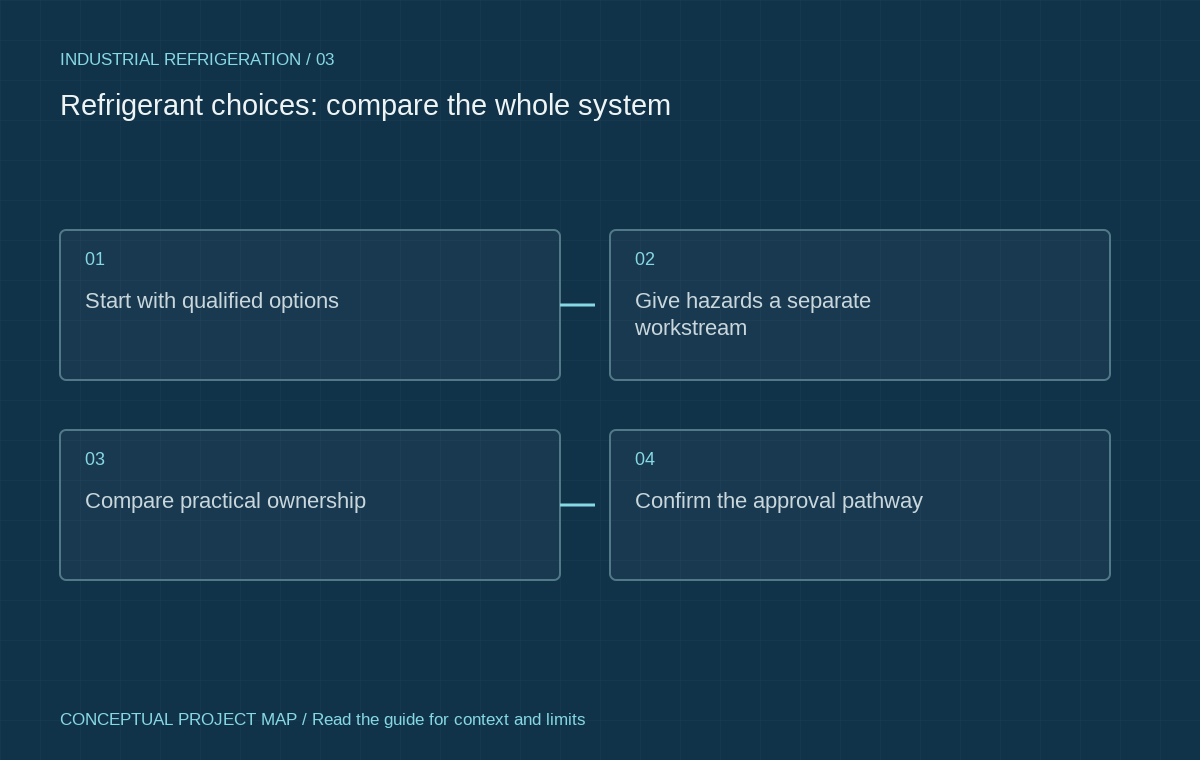
Start with qualified options
Ask the refrigeration designer to define technically suitable system alternatives for the process and site. Compare the complete arrangement, including secondary loops, heat rejection, controls and maintenance access. A refrigerant’s familiar name is not a project design.
Request current manufacturer documentation for the proposed equipment and operating envelope. Keep assumptions about ambient conditions, process demand and future expansion attached to the comparison.
Give hazards a separate workstream
Refrigerants have different hazard characteristics. Ammonia, for example, has serious toxicity and other hazards described by CCOHS. The project team must assess the actual substance, quantity, system and location using current supplier safety data and applicable requirements.
Do not use this page to select protective equipment, ventilation, detection thresholds or emergency actions. Those belong in a competent site-specific assessment and operating programme.
Compare practical ownership
Ask who can maintain each option locally, what training operators need and how service interruptions are handled. Identify specialist parts, monitoring dependencies and the proposed support model. Availability and response times need provider confirmation.
Compare capital and operating assumptions separately. A lower quoted equipment price can omit building changes, control integration or other necessary work; a claimed energy advantage needs a documented basis.
Confirm the approval pathway
Have the responsible professional identify the authority, registration and inspection steps for the selected proposal. In Alberta, use ABSA’s current guidance and direct project review where needed. Do not assume that a replacement has the same pathway as the old installation.
Record why the chosen alternative meets the project requirements and what remains unresolved. Preserve the final equipment, refrigerant and safety documentation for future operators.
References / Jurisdiction matters
Sources & further reading
Confirm the actual location, permit authority and equipment instructions before relying on a requirement. A source from another jurisdiction is identified for context.
- Refrigeration plants and pressure equipmentABSA — Alberta pressure equipment safety authority · 2026-10-13
- Ammonia chemical profileCanadian Centre for Occupational Health and Safety · 2026-10-13
- Occupational health and safetyGovernment of Alberta · 2026-10-13
Do not open equipment, handle refrigerants or work on energized systems. Permits, qualified trades and inspection requirements vary by location. This guide does not design an installation or certify existing equipment.